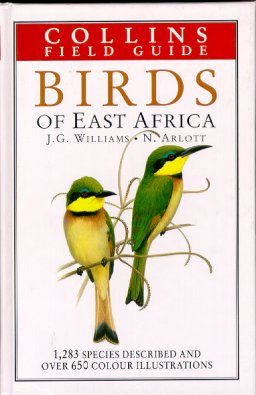


Book reviews: Birds of East Africa
|
Title |
| Birds of East Africa | |
| Author | |
| J.G. Williams, N. Arlott | |
| ISBN | |
| 0 00 2191 79 2 | |
| Edition | |
| Reprinted 1996 | |
| Publisher | |
| Harper Collins Publishers | |
| Pages | |
| 415 | |
| Order this book from Amazon (difficult to find) | |
| |
Standard birding field guide about east Africa. The book has a very strong hard cover and normal field guide size. In the center part of the book there are 48 plates with color drawings. As usual in this series the color drawings are on the right hand page, while on the left hand page there is a list with names and a short identification description. Differences between male/female or mature/immature are shown in seperate drawings. The first and last part of the book are reserved for species descriptions. Most have a paragraph about identification and another about distribution/habitat. Some birds have some additional information about voice or allied species. Allied species can be found also in the east African region but these species are not shown in seperate drawings. Therefore you have to identify them by description only. As shown on the cover, 650 species have drawings in the book while 1283 are described. So this field guide shows about half of the birds in east Africa.
I have used this book mainly for birding in west Africa. This may seem strange but at the time I was visiting west Africa, there was only one field guide available. The Collins field guide to Birds of West Africa, which is much less quality than this book. Since many east African species also occur in west Africa, I used this east African field guide there as well. There is another field guide to east African birds by Collins. The Collins Safari Guides, Common Birds of East Africa is paperback, slightly smaller and just 160 pages. its shows color photographs rather then drawings. This book concentrates on the 360 more common species of the region. For starting birders or people with a casual interest in birding this book would be better than the bigger field guide reviewed here. Personally I appreciate photographs more than drawings but with most birders this seems to be the other way around. In fact usually I take several field guides with me, with photographs and with drawings.
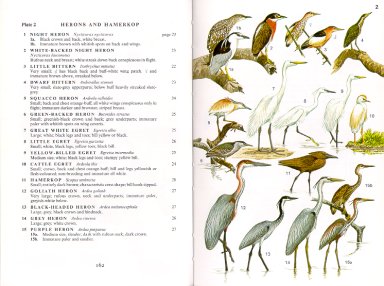 This
picture shows plate 2, a page with color drawings of herons. The birds are nicely drawn
and show the birds in their usual postures. Because the color plates are put in the middle
of the book, you need to go a lot back and forth but everything is easy to find.
This
picture shows plate 2, a page with color drawings of herons. The birds are nicely drawn
and show the birds in their usual postures. Because the color plates are put in the middle
of the book, you need to go a lot back and forth but everything is easy to find.
Conclusion: Standard birding field guide about east Africa. Has drawings of about half the species that occur in the region. Serious birders may want to look for a book that shows more species. Beginning birders may want the smaller safari guide with photographs of the more common species. Normally you'll find what you are looking for in this book. Nice drawings. All together, good book but not exceptional.
This book is out of print and may be hard to find, but you may try at Amazon:
All text and
images © 1991 - 2011 Hans Martens
Wildpicture.com