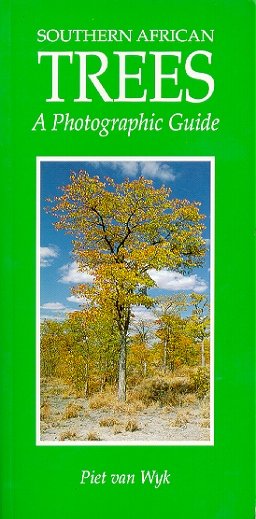


Book reviews: Southern African Trees
|
Title |
| Southern African Trees | |
| Author | |
| Piet van Wijk | |
| ISBN | |
| 1 86825 307 4 | |
| Edition | |
| Third impression 1996 | |
| Publisher | |
| Struik Publishers | |
| Pages | |
| 144 | |
| Order this book from Amazon | |
| |
Small pocket sized field guide in the photographic guide series by Struik. This books covers the more common trees of southern Africa. There are some 132 species of trees included, which is certainly not all of the species occurring in Africa. Dr. Piet van Wijk is a very well known other on the field of trees and plants in South Africa. I bought this book in South Africa in 1996 when I was there for my Field Guide training. Part of the practical exam is determination of trees. On the basis of the tree shape, the leaves and the bark you have to know both the english and the scientific name. This book shows most of the trees but didn't have all the differenct species in it that I needed. Therefore I had to buy another, bigger, field guide by the same author.
 Each tree in this book has a
page to itself. Photographs show the complete tree, to get an idea of the size and shape.
Thers are also photographs showing the bark, leaves, blossom and fruits where necessary. A
distribution map is also included, together with a text describing the tree.
Each tree in this book has a
page to itself. Photographs show the complete tree, to get an idea of the size and shape.
Thers are also photographs showing the bark, leaves, blossom and fruits where necessary. A
distribution map is also included, together with a text describing the tree.
Even with this book it is sometimes very hard to identify a tree.Of course there are
some very obvious trees which stand out very clearly. I think no one with some knowledge
of trees would be able to not identify a Baobab tree. But with other species it more
difficult, specially regarding the changes in season. With leaves or without, in blossom
or with fruits. This does change the appearance of a tree quite a lot. And it is
impossible to show each tree in all its variants in this little guide book. Learning about
trees is not something you just do in the absence of big game. Learning about plants is
learning about the environment, the total eco-system and it gives you a better
understanding how everything works together.
Conclusion: As with most books in this series, it is very small and handy. It is
a very nice book for anybody going on a safari in southern Africa with an interest in
trees. It is very clear and the more common trees are included. If your interest goes a
bit deeper, you may want to buy the bigger version of this book.
You can order this book directly from Amazon:
All text and
images © 1991 - 2011 Hans Martens
Wildpicture.com